Autonomous Hovercraft
Autonomous Hovercraft - The Power of Neural Nets
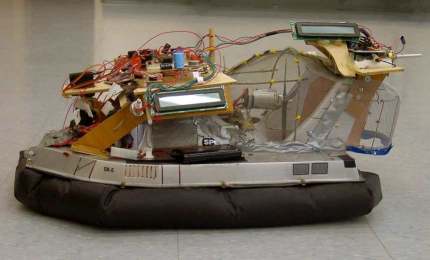
[ Abstract]
The engineering goal of this project was
to discover if it was possible to use artificial
intelligence to control a hovercraft autonomously.
There are several types of artificial
intelligence such as state machines, fuzzy
logic and artificial neural networks. This
project uses
an artificial neural network, as it can be
more adaptive in controlling an unstable
vehicle.
The hovercraft has three main boards: the
main computer, the artificial neural network
and the speed control board. An ultrasonic
rangefinder mounted on a servo provides the
vision of
the unit. The main computer board instructs
the rangefinder to emit a sound pulse and
wait for an
echo and then it calculates the distance
to the object based on the time taken for
the echo to
return. This data is sent to the neural network,
which then decides on the best course of
action to
avoid any collisions. The recommendations
of the neural network are processed by the
main
computer board and sent to the speed controller,
which uses pulse width modulation to control
the speed of the lift and propulsion motors,
and to a servo that controls the rudder.
The main
computer board communicates with the neural
network board and the speed control board
using
the Scalable Node Address Protocol that has
an error detection scheme.
It is possible to use an artificial neural
network to control a hovercraft autonomously;
however, properly training the neural network
is the key to accurate control. Artificial
neural
networks are a promising way of controlling
robots.
[Download]
You can visit the project on AVRFreaks at:
http://www.avrfreaks.net/Freaks/freakshow.php?action=2&projectid=84
Or download the same package here, which includes schematics, code, and lots of documentation…
[Awards]
This project was my entry in the Intel International Science and Engineering Fair. There I won an award: “American Association for Artificial Intelligence: For the best projects in the area of computer science with an artificial intelligence component. Award of $1,000”.